Skip to content
 The CompTIA Certification Roadmap: Which Cert to Get First (2026)
 Access Computer TrainingLive IT certification training · Tampa Bay & online · Updated August 2026
What Is the CompTIA Certification Roadmap?
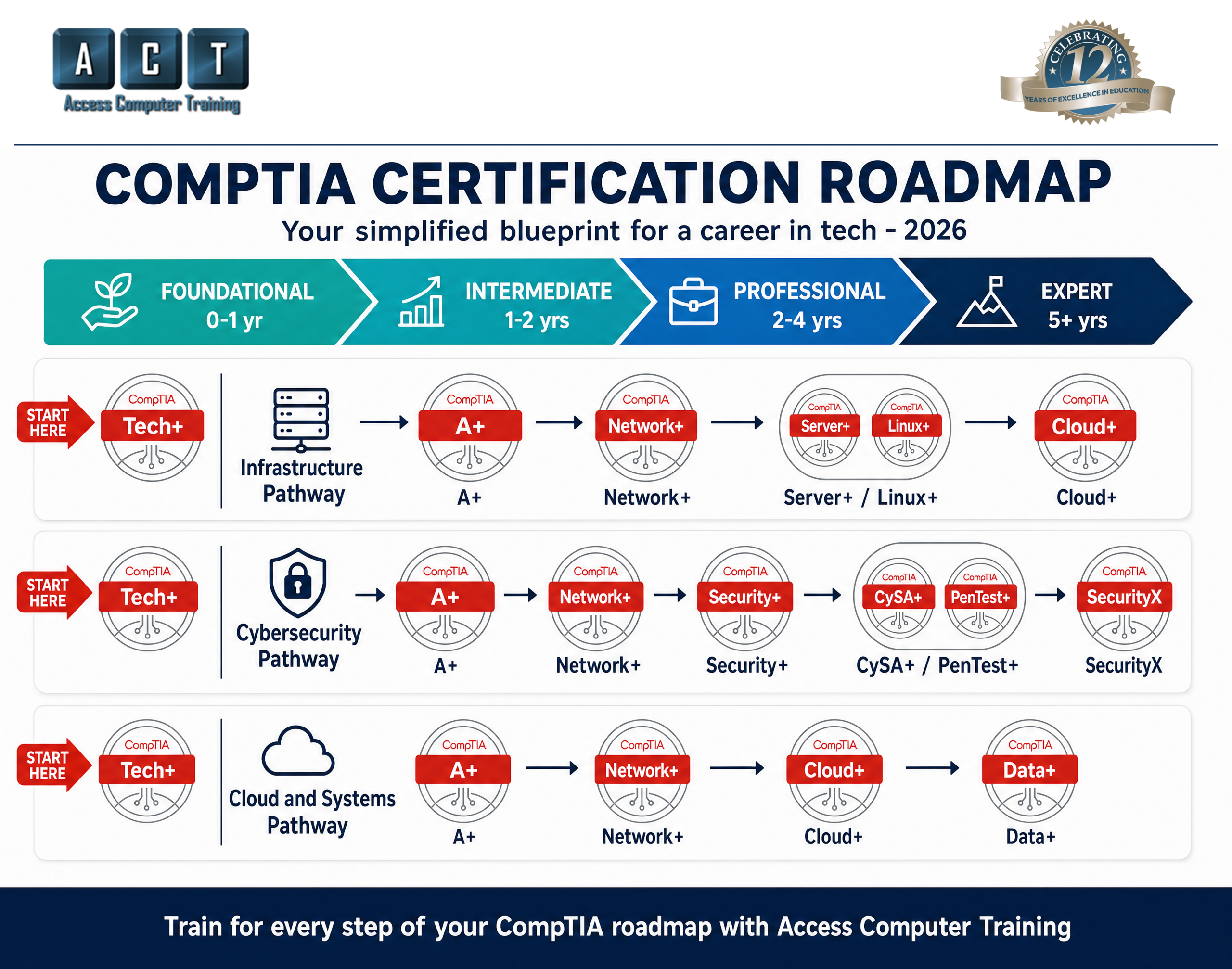
The CompTIA certification roadmap is the recommended order for earning CompTIA’s vendor-neutral IT certifications — from your very first support role all the way to advanced cybersecurity. Rather than guessing what to study next, the roadmap groups the certifications into four logical tiers, so you always know the smart next step for your goals and budget.
CompTIA certifications are vendor-neutral, meaning they prove foundational skills that transfer across employers and technologies — which is exactly why hiring managers use them to screen entry-level and mid-level candidates. Here is the roadmap at a glance:
Tap any highlighted certification to see ACT’s live training for it. Tech+, Server+ and SecurityX are shown for context; ACT’s core tracks focus on A+, Network+, Security+, Cloud+, Linux+, CySA+ and PenTest+.
The CompTIA Certifications in Order
Most people follow the roadmap in this sequence. It’s roughly the CompTIA certifications in order of difficulty, too — each one builds on the skills before it.
| Certification | Tier | Exam | Best for |
|---|---|---|---|
| CompTIA A+ | Foundation | Core 1 & Core 2 | Your first IT support / help desk role |
| CompTIA Network+ | Infrastructure | N10-009 | Network technician, NOC, junior sysadmin |
| CompTIA Linux+ | Infrastructure | XK0-005 | Linux admin, DevOps foundations |
| CompTIA Cloud+ | Infrastructure | CV0-003 | Cloud support & operations |
| CompTIA Security+ | Cybersecurity | SY0-701 | The baseline cybersecurity credential |
| CompTIA CySA+ | Cybersecurity | CS0-003 | SOC / security analyst, threat detection |
| CompTIA PenTest+ | Cybersecurity | PT0-002 | Penetration testing, ethical hacking |
Exam codes change as CompTIA refreshes each exam — confirm the current version before you register.
Which CompTIA Certification Path Fits Your Goal?
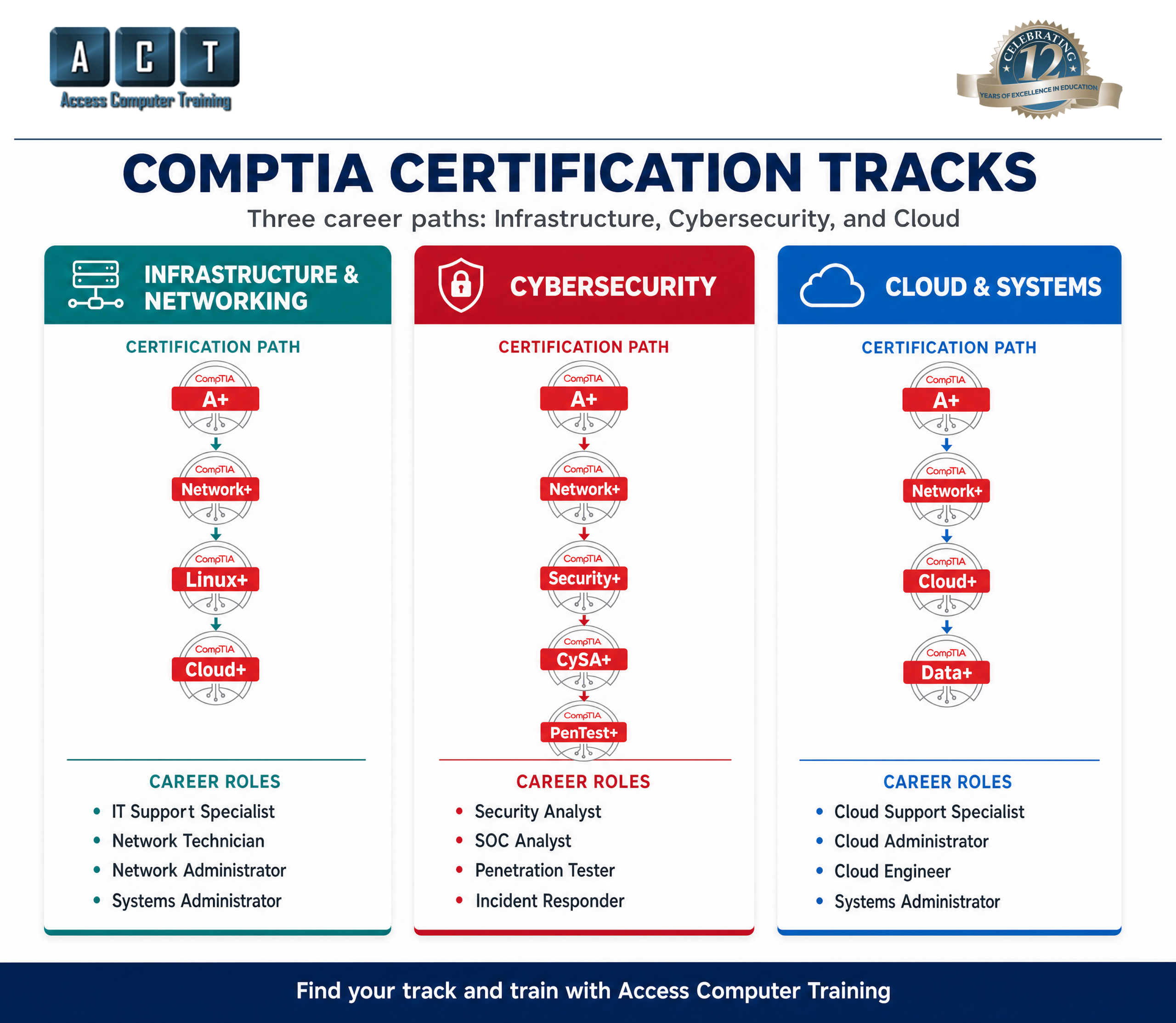
Everyone starts with A+, then branches based on the career you want. Here are the three most common CompTIA certification paths:
Infrastructure & Networking
Track 1A+ → Network+ → Cloud+ / Linux+. The path to network technician, systems administrator, and cloud-support roles — the backbone jobs every organization needs.
Cybersecurity
Track 2A+ → Network+ → Security+ → CySA+ / PenTest+. The fastest recognized route into SOC analyst, security analyst, and incident-response roles — one of the highest-demand fields in tech.
Cloud & Systems
Track 3A+ → Network+ → Cloud+. For cloud-support and operations roles as more Tampa Bay employers migrate to the cloud — pairs naturally with Microsoft Azure.
Each CompTIA Certification, Explained
A quick, plain-English look at each certification on the roadmap — what it proves, who it’s for, and the ACT course that prepares you for it.
CompTIA A+
FoundationThe entry point to IT: hardware, operating systems, troubleshooting, networking basics, and security fundamentals. If you’re new to tech, start here — it’s what unlocks help desk and support roles.
CompTIA Network+
InfrastructureConfiguring, managing, and troubleshooting wired and wireless networks. The credential that opens network-technician, NOC, and junior-sysadmin roles — and a prerequisite mindset for cybersecurity.
CompTIA Security+
CybersecurityThe baseline cybersecurity certification — threats, risk, secure architecture, and compliance. Often the single most requested cert in entry-level security job postings, and a common DoD/8570 requirement.
CompTIA Cloud+
InfrastructureDeploying, securing, and operating cloud and hybrid environments. A strong pairing with Network+ as employers move workloads to the cloud.
CompTIA CySA+
CybersecurityBehavioral analytics, threat detection, and incident response for SOC and security-analyst roles — the natural step up after Security+.
CompTIA PenTest+
CybersecurityHands-on penetration testing and vulnerability assessment — ethical-hacking tools, techniques, and reporting for offensive-security roles.
CompTIA Linux+
InfrastructureLinux system administration — command line, scripting, security, and troubleshooting. Valuable for server, cloud, and DevOps-track careers.
How Much Do CompTIA Certifications Cost?
Exam voucher prices vary by certification. These are approximate U.S. list prices — and a big reason to train with a school that includes the voucher rather than buying each exam separately.
| Certification | Approx. exam fee (USD) |
|---|---|
| CompTIA A+ (two exams) | ~$253 each (~$506 total) |
| CompTIA Network+ | ~$369 |
| CompTIA Security+ | ~$404 |
| CompTIA Cloud+ / Linux+ | ~$369 |
| CompTIA CySA+ / PenTest+ | ~$404 |
Every ACT certification program includes an exam voucher and one retake, so you don’t pay these fees on top of tuition — and depending on your situation, funding may cover part or all of your training.
CompTIA Certification Salaries: What Each Pays
Certifications translate directly into earning power. Here are typical U.S. pay ranges for the roles each cert unlocks — entry-level candidates start toward the lower end and climb as they stack certs and experience.
| Certification | Typical role | U.S. pay range |
|---|---|---|
| CompTIA A+ | Help desk / IT support | $40k–$55k |
| CompTIA Network+ | Network tech / jr. sysadmin | $50k–$68k |
| CompTIA Security+ | Security analyst | $65k–$90k |
| CompTIA CySA+ | SOC / cybersecurity analyst | $80k–$110k |
| CompTIA Cloud+ / Linux+ | Cloud support / Linux admin | $70k–$105k |
National estimates; actual pay varies by employer, experience, and clearance. For local figures, see our IT jobs in Tampa Bay guide.
Which CompTIA Certification Should You Get First?
The right first certification depends on where you’re starting. Use this quick guide:
- New to IT with no experience? Start with CompTIA A+. It’s the on-ramp to help desk and support roles and the foundation everything else builds on.
- Already in an IT role and want to move up? Go to Network+ for networking and systems roles.
- Aiming for cybersecurity? Build the A+/Network+ base, then earn Security+ — the credential most entry security jobs ask for.
- Career-changer in your 30s, 40s, or 50s? A+ first, then Security+, is the most reliable funded path from “no experience” to hired.
Not Sure Which Cert to Start With?
Book a free Career Strategy Call and we’ll map your CompTIA roadmap to a real job — and check what funding you may qualify for.
Book a Free Career Strategy Call or call 855-9-LEARNIT (855-953-2764)✓How to Earn Your CompTIA Certifications
You don’t have to figure the roadmap out alone. Here’s how ACT students move from “where do I start?” to certified and hired:
- Map your pathOn a free strategy call, we match you to a target role and the first certification that gets you there.
- Train live with an instructorLive, instructor-led classes with hands-on labs — not pre-recorded videos — and sessions recorded for 24/7 review.
- Practice and passA practice-exam gate plus your included exam voucher and one retake so you sit the exam ready.
- Stack the next cert & get hiredMove up the roadmap while our career coaching — resume, LinkedIn, interview prep — helps you land the role.

Train for Your CompTIA Certification Roadmap with ACT
Access Computer Training is a Florida CIE-licensed school (#5237) that turns that roadmap into a funded, guided career path — live online across Florida and in person in the Tampa Bay area.
- Live, instructor-led CompTIA training with hands-on labs
- Exam voucher and one retake included in every certification program
- Full career coaching — resume, LinkedIn, and interview prep — for 90 days after you finish
- Depending on your employment status and county, you may qualify for workforce grant funding that can cover part or all of your tuition
Eligibility and award amounts are determined by the funding agency, not by ACT — we’ll help you check what you may qualify for on your free call. See all funding options or read real graduate success stories.
CompTIA Certification FAQs
What is the CompTIA certification roadmap?
It’s the recommended order for earning CompTIA’s vendor-neutral IT certifications, grouped into four tiers — Foundation (A+), Infrastructure (Network+, Cloud+, Linux+), Cybersecurity (Security+, CySA+, PenTest+), and Expert (SecurityX). It gives you a clear next step at every stage of your IT career.
Which CompTIA certification should I get first?
If you’re new to IT, start with CompTIA A+ — it unlocks help desk and support roles and is the foundation for everything else. If you already work in IT, Network+ or Security+ may be the better first step depending on your goal.
What are the CompTIA certifications in order?
A common order is A+ → Network+ → Security+, then a specialization such as CySA+ or PenTest+ (cybersecurity) or Cloud+ and Linux+ (infrastructure). That sequence roughly matches the certifications in order of difficulty, since each builds on the last.
How much do CompTIA certifications cost?
Individual exam vouchers range from about $253 (each A+ exam) to about $404 (Security+, CySA+, PenTest+). Every ACT program includes the voucher and one retake, and funding may cover part or all of your training.
How long does it take to get CompTIA certified?
Most learners can prepare for a single certification in a few weeks to a couple of months of focused, instructor-led study. Your timeline depends on the certification and how much time you can commit — we’ll map a realistic one on your free call.
Do CompTIA certifications expire?
Most CompTIA certifications (A+, Network+, Security+ and above) are valid for three years and can be renewed through CompTIA’s continuing-education program or by earning a higher-level certification — which is another reason the roadmap works in your favor.
Are CompTIA certifications worth it without a degree?
Yes. Because they’re vendor-neutral and widely recognized, CompTIA certifications are how many employers screen entry-level talent — skills and certs often matter more than a four-year degree for support, network, and security roles.
Start Your CompTIA Roadmap Today
Book a free Career Strategy Call and we’ll map the right certification, the path to your target job, and the funding you may qualify for — in about 15 minutes.
Book a Free Career Strategy Call or call 855-9-LEARNIT (855-953-2764) · 5.0★ from 117 reviews · Florida CIE-licensed #5237Sources: CompTIA — official certifications and the U.S. Bureau of Labor Statistics, Computer & IT Occupations. Exam codes, pricing, and salary figures are estimates — verify current details before you rely on them.