 Skip to content

Are IT Certifications Worth It? How They Compare to a Degree
Are IT certifications worth it if you don’t have a degree? For a lot of people starting in tech, the answer is yes, but not because certifications have replaced degrees. They’re worth it because they’re a faster, cheaper way to prove job-ready skills for the roles where employers accept them.
This guide from Access Computer Training (ACT) looks at the question honestly, using data from the U.S. Bureau of Labor Statistics (BLS), the College Board, and hiring research, so you can decide which path fits your goals.

Are IT Certifications Worth It? The Short Answer
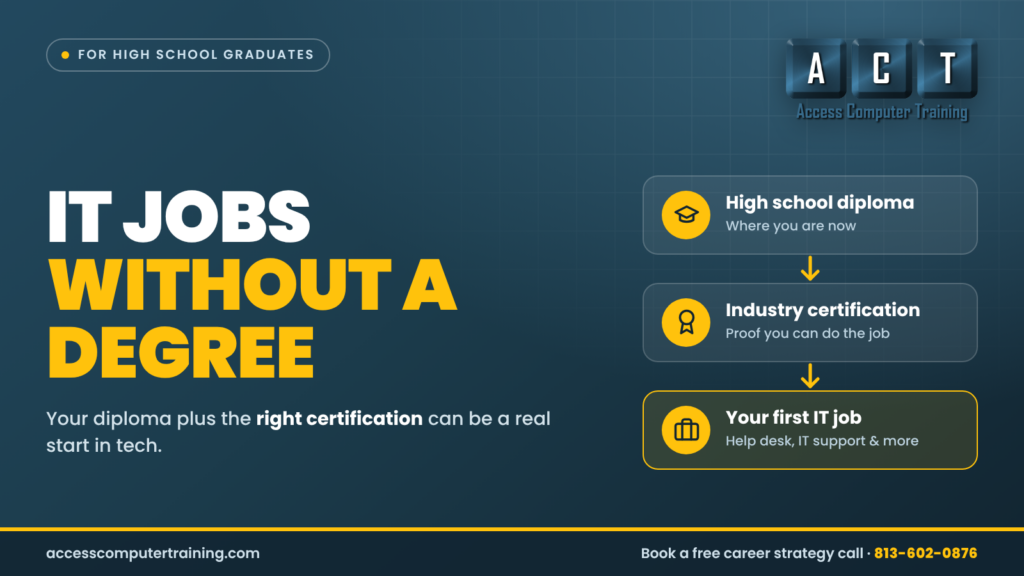
For entry-level IT support and many networking jobs, yes. The BLS profile for computer support specialists says candidates “may qualify with a high school diploma plus relevant information technology (IT) certifications.”
For more advanced roles, certifications work alongside a degree and experience rather than replacing them. In cybersecurity, for example, the BLS says information security analysts “typically need a bachelor’s degree,” but also that “some workers enter the occupation with a high school diploma and relevant industry training and certifications,” and that “many employers prefer to hire candidates who have information security certification.”
IT Certifications vs. a Degree at a Glance
Are IT certifications worth it compared with a four-year degree? Here’s how the two paths stack up on time, cost, and what they prove.
| Factor | IT certification | Bachelor’s degree |
|---|---|---|
| Time | Weeks to months of training per certification | Usually designed as four years of full-time study |
| Cost | Training plus exam fees (for example, AWS lists its Cloud Practitioner exam at $100 and Cisco lists CCNA at US$300) | Average published tuition and fees of $11,950 a year at public four-year schools for in-state students (2025–26) |
| What it proves | Specific, current job skills, tested by the vendor or CompTIA | Broad education plus a field of study |
| Staying current | Many expire and must be renewed (CompTIA’s cycle is three years) | Doesn’t expire |
| Best for | Getting hired into entry-level IT and moving up within a specialty | Roles where employers typically expect a degree, and management tracks |
Tuition figures come from the College Board’s Trends in College Pricing. Published prices aren’t what everyone pays: the College Board estimates average net tuition and fees after grant aid at about $2,300 for in-state students at public four-year schools in 2025–26. Renewal details come from CompTIA’s continuing education page.
Are IT Certifications Worth It for You? 5 Factors to Weigh
Are IT certifications worth it for your situation? The right answer depends on your goals, and these five factors make the decision clearer.
1. The job you want
Different IT jobs ask for different things. Entry-level support roles are the most open to certifications, while senior roles usually expect a degree, experience, or both. Here’s what the BLS reports:
| IT role | Typical entry-level education | What the BLS says about certifications | Median pay (May 2025) |
|---|---|---|---|
| Computer user support specialists | Some college courses | May qualify with a diploma plus IT certifications | $61,860 |
| Computer network support specialists | Associate’s degree | Same note applies to support roles overall | $76,220 |
| Network and computer systems administrators | Bachelor’s degree | Employers may require certification in the products they use | $99,130 |
| Information security analysts | Bachelor’s degree | Many employers prefer certified candidates | $129,180 |
| Computer network architects | Bachelor’s degree plus 5 or more years of experience | Usually reached after years in related IT roles | $134,050 |

If you’re aiming for your first IT job, certifications line up well with the roles at the top of this table. Our guide to IT jobs you can get without a degree covers those starting roles in detail.
2. Your time and budget
A certification path usually takes months, not years. At ACT, for example, the CompTIA A+ program runs about four to eight weeks, including time to pass both exams. A bachelor’s degree is usually designed as four years of full-time study, and the College Board puts average published tuition and fees at $4,150 a year at public two-year colleges and $45,000 at private nonprofit four-year schools in 2025–26. Faster training also means you can start earning and building experience sooner.
3. How employers actually hire
You may have heard that employers are dropping degree requirements. Some are, but hiring has changed less than the headlines suggest. A February 2024 report from the Burning Glass Institute and Harvard Business School found “an almost fourfold increase” in roles where employers dropped degree requirements, yet the change showed up in “not even 1 in 700 hires” the year before.
The same report found that at the companies it calls skills-based hiring leaders, workers without bachelor’s degrees had retention rates 10 percentage points higher than their degree-holding colleagues. So are IT certifications worth it if hiring hasn’t changed as much as expected? Yes, as long as you treat them as a door-opener: a certification gets your résumé considered, but you still have to prove your skills with hands-on labs, projects, and interview answers.
4. Long-term pay
On average, more education still pays more. In 2025, the BLS reports median weekly earnings of $966 for workers with a high school diploma, $1,135 with an associate’s degree, and $1,578 with a bachelor’s degree, according to its earnings by education table. Those figures cover all fields, not just IT, but they’re a fair reminder that a degree can raise your ceiling over a career.

Within IT, though, certifications and experience can carry you a long way. A help desk technician who adds Network+ and Security+ and builds experience can work toward networking or security roles, which carry higher median pay in the BLS table above.
5. Government and defense work
If you want to work on Department of Defense (DoD) contracts or in DoD cyber roles, certifications carry extra weight. Under the DoD 8140 program, workers meet a foundational qualification through “education, certification, and training as prescribed by DoDM 8140.03,” according to the DoD 8140 qualification guidance. A commercial certification such as CompTIA Security+ is one of those routes, which is why you’ll often see it listed as a DoD 8570/8140 baseline credential.
Not Sure Which Path Fits You?
Book a free, no-pressure career strategy call. We’ll look at your goals, experience, and budget and tell you honestly whether certifications, a degree, or both make sense for you.
Book Your Free Strategy Call → or call 855-9-LEARNITWhen a Degree Makes More Sense
Are IT certifications worth it for everyone? Not always. A degree may be the better investment if:
- You’re set on a role where the BLS lists a bachelor’s degree as typical, such as systems administration, security analysis, or network architecture
- You want a management track later in your career
- A specific employer you’re targeting requires a degree for the role
- You qualify for enough grant aid to make a degree affordable
- You have the time to study for several years before you need to earn
The Best of Both: Certifications Now, a Degree Later
It doesn’t have to be one or the other. One option is to use certifications to get hired, build experience, and then decide whether a degree is worth adding. The BLS notes that many information security analysts come from other IT roles, often as network and computer systems administrators, which is a path you can start with certifications.
Starting with certifications also lets you test the field before you commit years and tuition to it. If you’re new to tech, our guide on how to start a career in IT with no experience walks through the first steps.
Which IT Certifications Are Worth It First?
If you’re starting from scratch, these three CompTIA certifications build on each other and match the entry-level roles above:
- CompTIA A+ (220-1201 and 220-1202): two exams covering hardware, software, operating systems, and troubleshooting. It’s built for entry-level help desk and support roles. See whether CompTIA A+ is worth it.
- CompTIA Network+ (N10-009): networking fundamentals for network support roles. Our Network+ guide explains the exam.
- CompTIA Security+ (SY0-701): core cybersecurity skills and a common DoD 8570/8140 baseline credential. CompTIA’s next version, SY0-801, launches November 17, 2026.
From there, you can specialize in cloud, networking, or cybersecurity. Our list of the best IT certifications lays out the options by career stage.
Earn IT Certifications With ACT
Based in Tampa Bay, ACT offers live, instructor-led certification prep online, with classes capped at 12 students and every live class recorded for review. Each of the programs below includes exam vouchers with retake assurance, plus practice labs.
- CompTIA A+: about four to eight weeks, including time to pass both exams
- CompTIA Network+: 60 clock hours of live instruction
- CompTIA Security+: 60 clock hours of live instruction
- Information Technology Career Prep: 350 clock hours, about nine months, combining Business Applications, A+, Network+, and Security+ with three exam vouchers
ACT programs include career support: career planning and skills alignment, a résumé rewrite, a LinkedIn profile audit and optimization, job-search strategizing, and one-on-one career coaching. You may qualify for grants and other funding options. No certification guarantees a job, but the right training and support make you a stronger candidate. Not sure where to start? Take our free 2-minute career quiz.
Frequently Asked Questions
Are IT certifications worth it without a degree?
For many entry-level roles, yes. The BLS says computer support candidates may qualify with a high school diploma plus relevant IT certifications. For senior roles such as security analyst or network architect, employers more often expect a degree, experience, or both.
Can an IT certification replace a degree?
Sometimes. For help desk and support jobs, certifications plus skills can be enough to get hired. For roles where the BLS lists a bachelor’s degree as typical, certifications usually strengthen your application rather than replace the degree.
Are IT certifications worth it for career changers?
They can be, especially if you want to move into IT without spending years back in school. Certification training takes months rather than years (ACT’s CompTIA A+ program runs about four to eight weeks, including both exams), and skills from your current job, such as customer service, can carry over to help desk work.
Which IT certification should I get first?
If you’re new to IT, CompTIA A+ is a logical first step, followed by Network+ and Security+. That order builds from hardware and support to networking and cybersecurity, matching common entry-level roles.
How long do IT certifications last?
It depends on the certification. CompTIA certifications such as A+, Network+, and Security+ are valid for three years and can be renewed through continuing education. Cisco’s CCNA and the AWS Cloud Practitioner certification are also valid for three years.
Do employers care more about certifications or degrees?
It depends on the role and the employer. More employers have dropped degree requirements from job postings, but research from the Burning Glass Institute and Harvard Business School found that actual hiring changed far less. Your best bet is to pair certifications with proof of skills, such as labs, projects, and experience.
So, Are IT Certifications Worth It?
Are IT certifications worth it? For many people trying to break into tech, yes: they’re faster and cheaper than a degree, and they line up with entry-level roles where the BLS says a diploma plus certifications may be enough. Just go in with clear eyes. Pair your certifications with hands-on skills, plan your next step up, and keep a degree on the table if your long-term goals call for it.
Start Your IT Certification Path With ACT
Talk with an ACT advisor about upcoming class dates, which certification fits your goals, and the funding options you may qualify for. It’s free and there’s no obligation.
Book Your Free Career Strategy Call → or call 855-9-LEARNIT