 Skip to content

High Paying Tech Jobs: 9 Roles Worth Training For and the Fastest Way In
- Tech starts from a strong baseline. Computer and IT occupations had a median wage of $109,470 in May 2025, more than double the $50,980 median for all occupations.
- The top tier takes time. The best-paid roles, such as IT manager and network architect, usually call for a bachelor’s degree and five or more years of related experience.
- Certifications open the first doors. Help desk, network support, and entry-level security roles often hire on skills and credentials like CompTIA A+, Network+, and Security+.
- AI is part of the demand story. The BLS cites artificial intelligence as one reason employers need more security analysts, network architects, and software developers.
If someone at your family dinner works in tech, you have probably heard some version of the same story: the pay is good, the work keeps changing, and they wish they had started sooner. It raises a fair question. Which high paying tech jobs are realistic for someone starting from zero, and how long does the climb take? This guide ranks nine roles using federal pay data, shows which ones certifications can lead to, and lays out the path Access Computer Training (ACT) students use to go from a first IT job toward six figures.
The median tech wage is more than double the median for all U.S. jobs, and you don’t need a computer science degree to get your foot in the door. Most people who land high paying tech jobs start in IT support, earn a few certifications, and move up into networking, security, or management.
What Counts as a High Paying Tech Job?
A high paying tech job is one whose median pay sits near or above $100,000 a year, roughly double the $50,980 median for all occupations. Computer and IT occupations as a group had a median wage of $109,470 in May 2025, according to the U.S. Bureau of Labor Statistics (BLS), so tech starts from a strong baseline.
Median annual wage for computer and information technology occupations in May 2025, versus $50,980 for all occupations, per the U.S. Bureau of Labor Statistics.
Openings projected each year, on average, in computer and IT occupations from 2025 to 2035, from new jobs and from replacing workers who leave the field.
Two things to keep in mind when you compare high paying tech jobs. First, median means half of workers earn more and half earn less, so entry-level offers start lower and climb with experience. Second, location matters. If you live in Florida, our breakdown of high-paying IT jobs in Tampa Bay and our Tampa IT salary guide show what local employers pay.
9 High Paying Tech Jobs, Ranked by Median Pay
These nine high paying tech jobs come from the BLS Occupational Outlook Handbook, ranked by May 2025 median pay. The top six all clear $125,000, and even the ninth, network and computer systems administrator, sits just under $100,000. The last column shows what employers typically expect at entry, which matters as much as the salary.
| # | Role | Median pay (May 2025) | Typical entry requirement |
|---|---|---|---|
| 1 | Computer and information systems manager (IT manager) | $175,140 | Bachelor’s degree plus 5 or more years of related experience |
| 2 | Computer and information research scientist | $140,300 | Master’s degree |
| 3 | Software developer | $135,980 | Bachelor’s degree |
| 4 | Computer network architect | $134,050 | Bachelor’s degree plus 5 or more years of related experience |
| 5 | Information security analyst | $129,180 | Bachelor’s degree plus less than 5 years of related experience |
| 6 | Database administrator or architect | $126,760 | Bachelor’s degree |
| 7 | Computer systems analyst | $105,850 | Bachelor’s degree |
| 8 | Web developer or digital designer | $99,520 | Bachelor’s degree |
| 9 | Network and computer systems administrator | $99,130 | Bachelor’s degree |

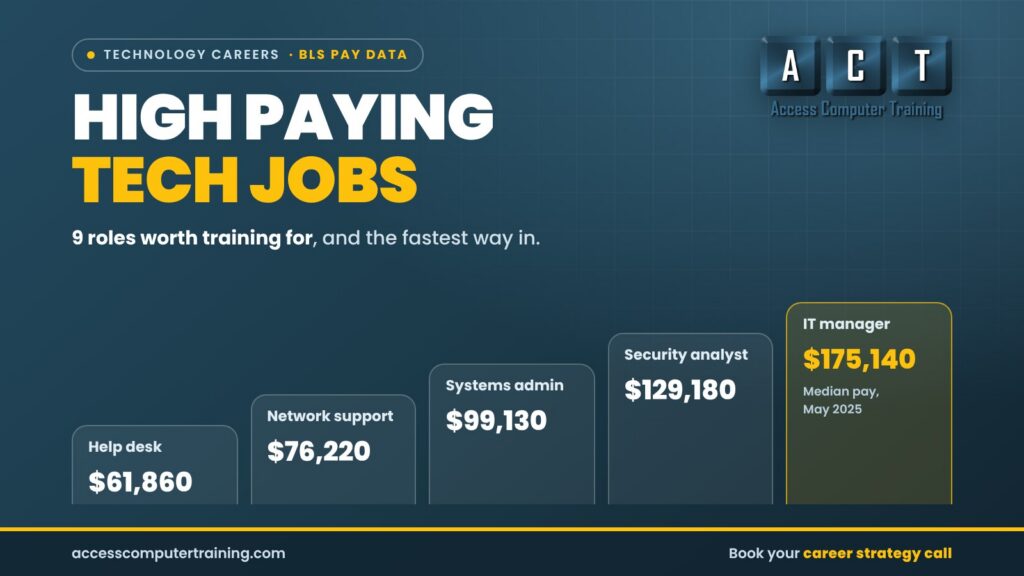
The classic first IT jobs pay less, but they are where most high paying tech jobs begin. Computer user support specialists, the help desk role, earned a median $61,860 in May 2025, and computer network support specialists earned $76,220, per the BLS.
Which High Paying Tech Jobs Can Certifications Unlock?
Certifications matter most in infrastructure and security roles, where employers hire on proven skills. Four high paying tech jobs on the list have well-worn certification paths: information security analyst, network and computer systems administrator, computer network architect, and IT manager. Each still expects experience, but the right credentials help you get hired at the first rung and promoted after that.
Information security analyst
$129,180 median. Analysts monitor for attacks, investigate alerts, and harden systems. The BLS projects 21% growth from 2025 to 2035 and notes that some workers enter with a high school diploma plus industry training and certifications. Common path: A+, Network+, Security+, then CySA+.
Network and computer systems administrator
$99,130 median. Admins keep servers, networks, and user accounts running. The BLS projects a 4% decline in employment from 2025 to 2035 but still expects about 13,400 openings a year. Common path: A+, Network+, then Linux+ or cloud skills.
Computer network architect
$134,050 median. Architects design the networks that admins run. The BLS projects 8% growth, much faster than average, and expects 5 or more years of related experience, so most architects come up through network administration. Common path: Network+, then Cisco’s CCNA and cloud certifications.
IT manager
$175,140 median. IT managers plan and direct an organization’s technology. The BLS projects 16% growth from 2025 to 2035. You need years of hands-on experience first, and project management credentials help; our CAPM vs PMP guide explains the difference.
Notice the pattern: the high paying tech jobs in this guide are built on the same fundamentals of hardware, networking, and security, which is why most paths begin with the same two or three CompTIA certifications. If you’re weighing options, our guide to the best IT certifications compares them side by side.
Can You Get a High Paying Tech Job Without a Degree?
Yes, but usually not on day one. Most top-paying roles list a bachelor’s degree as the typical entry point, yet the BLS notes that some information security analysts enter with a high school diploma plus industry training and certifications. The common route is to start in IT support, stack certifications and experience, and move up.
Experience is the bridge from those starting points to high paying tech jobs. For infrastructure and security work, employers often weigh hands-on experience and certifications alongside formal education, and the BLS notes that employers may prefer to hire security analysts who hold a professional certification. Our guides to IT jobs without a degree and how to get a help desk job walk through that first step. Switching fields later in life? Read about making a career change to IT at 40.
What Is the Realistic Path From Help Desk to Six Figures?
The realistic path to high paying tech jobs is a ladder: an entry-level support job, then networking or systems work, then security, architecture, or management. Each rung pays more than the last and builds the experience the next one asks for. Your pace depends on your study time and the job market, so treat it as a map.
- Learn the fundamentals and earn CompTIA A+ A+ covers hardware, software, troubleshooting, and security basics across two exams, Core 1 (220-1201) and Core 2 (220-1202). It is a common first credential for help desk roles.
- Land your first IT support job Help desk, desktop support, or IT support specialist. The median for computer user support specialists was $61,860 in May 2025, and the job teaches you how real systems break.
- Add Network+ and move into networking Network+ (N10-009) prepares you for network support and junior admin work. Network support specialists earned a median $76,220.
- Step into security or systems administration Security+ is the widely recognized next step. You can take SY0-701 until June 11, 2027, or the new SY0-801 that launched November 17, 2026. Systems administrators earned a median $99,130, and information security analysts earned $129,180.
- Grow into architecture or management With five or more years of related experience, the top high paying tech jobs, such as network architect ($134,050) and IT manager ($175,140), become realistic targets.

Not sure which branch fits you? Our guide to which tech career is right for you helps you match your strengths to a direction before you spend a dollar on training.
Are High Paying Tech Jobs Safe From AI?
No job is untouched by AI, but the BLS points to AI as a source of demand for several high paying tech jobs. It cites AI when explaining growth for information security analysts, network architects, software developers, and IT managers. Roles that combine technical skill with judgment and responsibility for real systems are the hardest to automate.
- Information security analysts: “Increased use of artificial intelligence (AI) and the rise of e-commerce have increased the need for enhanced security,” according to the BLS.
- Network architects: Companies looking to leverage technology investments such as AI “will need these workers.”
- Software developers: Growth is tied in part to the “continued expansion of software development for artificial intelligence (AI).”
- IT managers: Demand follows the spread of cloud computing, cybersecurity, digital platforms, and AI.
The bigger picture points the same way. The World Economic Forum’s Future of Jobs Report 2025 expects 170 million jobs to be created and 92 million displaced by 2030, a net gain of 78 million, and lists AI and big data, networks and cybersecurity, and technology literacy as the fastest-growing skills.
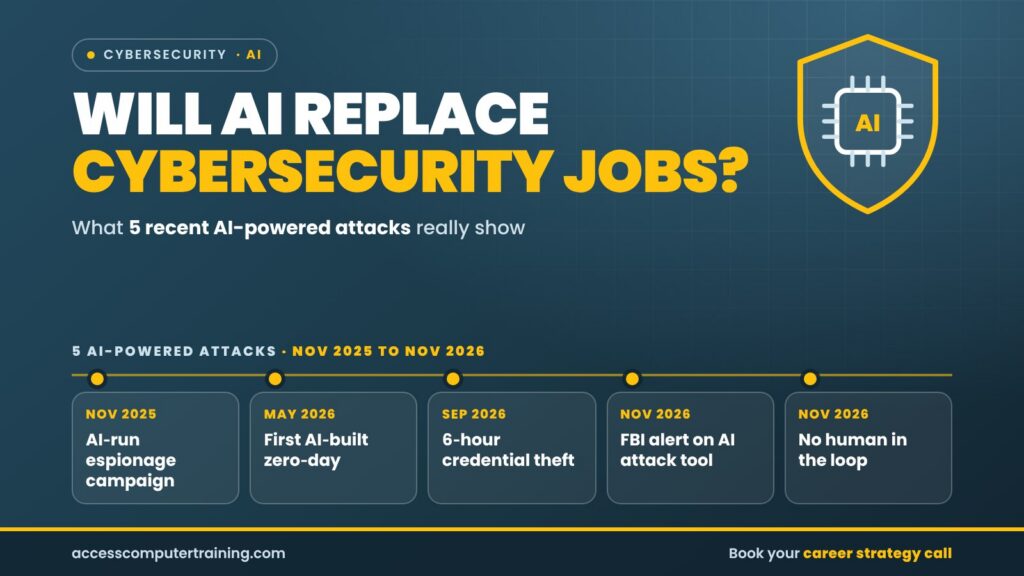
The flip side is that routine tasks keep getting automated, from password resets to basic scripting. That’s a reason to keep climbing toward high paying tech jobs, not a reason to skip the first rung. For a closer look at the security side, read Will AI Replace Cybersecurity Jobs?, our breakdown of five recent AI-powered attacks.
How Long Does It Take to Land a High Paying Tech Job?
Plan on a few years to reach six figures, but your first IT job can come much sooner. Focused training gets you certified in weeks or months: ACT’s CompTIA A+ program takes 4 to 8 weeks, including both exams. From there, experience and additional certifications move you up the pay scale one rung at a time.
| ACT program | Live training | Typical length | Certifications | Builds toward |
|---|---|---|---|---|
| CompTIA A+ | 92 hours | 4 to 8 weeks, including both exams | A+ (Core 1 and Core 2) | Help desk, desktop support |
| IT Network & Security | 212 hours | About 6 months | A+, Network+, Security+ | Network support, junior admin, entry-level security roles |
| Cyber Defense & Incident Response | 180 hours | About 6 months | Security+, CySA+, PenTest+ | SOC analyst, security analyst |
| IT Career Prep | 350 hours | About 9 months | 3 certification exam vouchers, plus business software, AI, and digital literacy training | A full career change from scratch |
The right starting point toward high paying tech jobs depends on where you are today. Someone with no IT background often begins with A+ or a full pathway, while someone already working in support may move straight into security training. Our post on how long it takes to get CompTIA A+ breaks down that first step week by week.
Find Your Fastest Path Into Tech
Access Computer Training offers live, instructor-led CompTIA training online for Tampa Bay and all of Florida. Self-pay options are available, and workforce grant funding may cover part of the cost, depending on eligibility.
Book Your Career Strategy Call → or call 855-9-LEARNIT FL DOE Licensed · CIE License No. 5237How ACT Helps You Train for High Paying Tech Jobs
ACT helps you train for high paying tech jobs by covering the first rungs of the ladder in live, instructor-led classes, then helping you turn new certifications into interviews. Training happens online in small classes, and each program includes exam vouchers with retake assurance. ACT’s Security+ prep, for example, caps each class at 12 students and records every session.
- Practice exams, hands-on labs, performance-based question (PBQ) practice, ebooks, and study guides come with tuition
- Exam vouchers and retake assurance for the certifications in your program
- Career planning and skills alignment, so your training matches the jobs you want
- A resume rewrite plus a LinkedIn profile audit and optimization
- Job-search strategy and one-on-one career coaching
- Help exploring grants, if you qualify, and other funding options
Want proof the path works? Read our graduates’ success stories, or explore all ACT programs to compare your options.
Frequently Asked Questions
What is the highest paying tech job?
Among the roles in this guide, computer and information systems managers (IT managers) earn the most, with a median of $175,140 in May 2025, per the BLS. Among non-management roles, computer and information research scientists lead at $140,300, though most need a master’s degree.
What high paying tech jobs can you get without a degree?
Information security analyst is the most realistic six-figure target without a degree, since the BLS notes that some analysts enter with a high school diploma plus training and certifications. Most people get there by starting in help desk or network support, earning certifications such as Security+, and building experience.
Do high paying tech jobs require coding?
Not all of them. Software and web developers code every day, but network administrators, security analysts, and IT managers spend more of their time on systems, troubleshooting, and risk. Basic scripting helps in nearly every role, and many people pick it up on the job.
How much do entry-level tech jobs pay?
Computer user support specialists, a common first IT job, earned a median of $61,860 in May 2025, and network support specialists earned $76,220. Pay varies by location and employer, so check local data; our Tampa IT salary guide covers the Tampa Bay market.
What is the best first certification for a tech career?
For most beginners, CompTIA A+ comes first, because it covers the hardware, software, and troubleshooting skills that help desk roles need. Network+ and Security+ usually come next, and together the three form the core of many paths into high paying tech jobs.
Will AI replace high paying tech jobs?
AI is changing how tech work gets done, but the BLS still projects faster than average growth for computer and IT occupations overall and cites AI as a reason employers need more security analysts, network architects, and software developers. Routine tasks are the most exposed, so keep building skills as you climb.
Final Thought
High paying tech jobs aren’t reserved for people who started coding as kids. Most people in these roles climbed a ladder: a support job, a few certifications, and steady experience. Take the first step now, and the next time tech careers come up at the dinner table, the success story could be yours.
Ready to Start Your Climb?
Talk with an Access Computer Training advisor about which certification to start with, upcoming class dates, and self-pay options. Workforce grant funding may cover part of the cost, depending on eligibility.
Book Your Career Strategy Call → or call 855-9-LEARNIT FL DOE Licensed · CIE License No. 5237