 Skip to content

Will AI Replace Cybersecurity Jobs? What Recent AI-Powered Attacks Really Show
- Attackers are automating. Google’s threat researchers have seen AI frameworks find and exploit software flaws with no human in the loop.
- Defense still runs on people. Even an espionage campaign run 80% to 90% by AI needed human decisions, and defenders caught it.
- The outlook is strong. The BLS projects 21% growth for information security analysts from 2025 to 2035.
- AI skills are now security skills. The new CompTIA Security+ exam (SY0-801) tests the security risks of AI and AI-assisted workflows.
Cybersecurity headlines this year read like science fiction: AI agents that find software flaws on their own, a credential theft campaign built in under six hours, and an espionage operation run mostly by an AI model. If those stories come up at your dinner table, the next question is usually personal. Will AI replace cybersecurity jobs, including the one you might train for? Below are five AI-powered attacks reported since late 2025, what they reveal, and how Access Computer Training (ACT) prepares people for security work in the AI era.
Will AI replace cybersecurity jobs? Not likely. AI is making attackers faster, so companies need more people who can defend with it. Routine tasks like sorting alerts are being automated, while people who can investigate, decide, and respond are still in demand.
Will AI Replace Cybersecurity Jobs? The Short Answer
So far, the evidence says no. AI is changing cybersecurity jobs faster than it is eliminating them. In the ISC2 2025 Cybersecurity Workforce Study, 69% of security professionals said they have integrated, are testing, or are evaluating AI tools at work, and 73% expect AI to create more specialized skills.
Projected growth for information security analysts, 2025 to 2035, much faster than average, per the U.S. Bureau of Labor Statistics.
Security professionals who have integrated, are testing, or are evaluating AI tools, per the ISC2 2025 Cybersecurity Workforce Study.
If you’ve typed “will AI replace cybersecurity jobs” into a search bar, the honest answer is that AI changes the shape of the work. To see how, look at what attackers are actually doing with it.
Will AI Replace Cybersecurity Jobs? What 5 Recent Attacks Show
The attacks show AI making attackers faster and cheaper, not making defenders unnecessary. In each case, AI handled grunt work like scanning, coding, or scaling, and in each case security teams caught, disrupted, or traced the activity using their own skills and tools, increasingly including AI.
1. November 2025: an espionage campaign run mostly by AI
Anthropic reported that a group it assessed with high confidence to be Chinese state-sponsored manipulated Anthropic’s own Claude Code tool to target roughly thirty organizations, succeeding in a small number of cases. AI performed an estimated 80% to 90% of the campaign, with humans stepping in at perhaps 4 to 6 critical decision points, and the AI occasionally hallucinated credentials. The lesson: even a mostly automated attack needed people, and so did catching it.
2. May 2026: the first zero-day exploit believed to be built with AI
Google Threat Intelligence Group (GTIG) identified, for the first time, a threat actor using a zero-day exploit it believes was developed with AI: a two-factor authentication bypass in a popular open-source, web-based system administration tool. The criminal actor planned mass exploitation, but GTIG says its proactive counter-discovery may have prevented the exploit’s use. The lesson: defenders who went looking found it first.
3. September 2026: a credential theft campaign built in under six hours
A financially motivated actor used an AI coding chatbot, a prompt, and a set of agent instructions to plan, build, and run a mass credential harvesting campaign in less than six hours, compromising thousands of third-party credentials, The Hacker News reported. As GTIG chief analyst John Hultquist put it, “At this point, we can assume that all threat actors are using AI in some capacity.” The lesson: response times have to shrink from weeks to hours.
4. August to November 2026: an AI attack tool aimed at critical sectors
On November 13, 2026, the FBI issued a FLASH alert warning that ARTEX, one of several AI-enabled attack tools Google’s researchers track, had been used since at least August 2026 against financial services, government, technology, defense, healthcare, energy, and other sectors, according to Help Net Security. The lesson: every one of those sectors needs analysts who can spot AI-driven activity.
5. November 2026: exploits with no human in the loop
GTIG reported threat actors using large language model (LLM) frameworks to fully automate vulnerability discovery and exploitation without a human in the loop, a first. One framework, exploit_agent, compares code before and after a patch, drafts an exploit, and runs it automatically. The lesson: these tools still leave distinct code-level traces, and trained analysts can hunt for them.
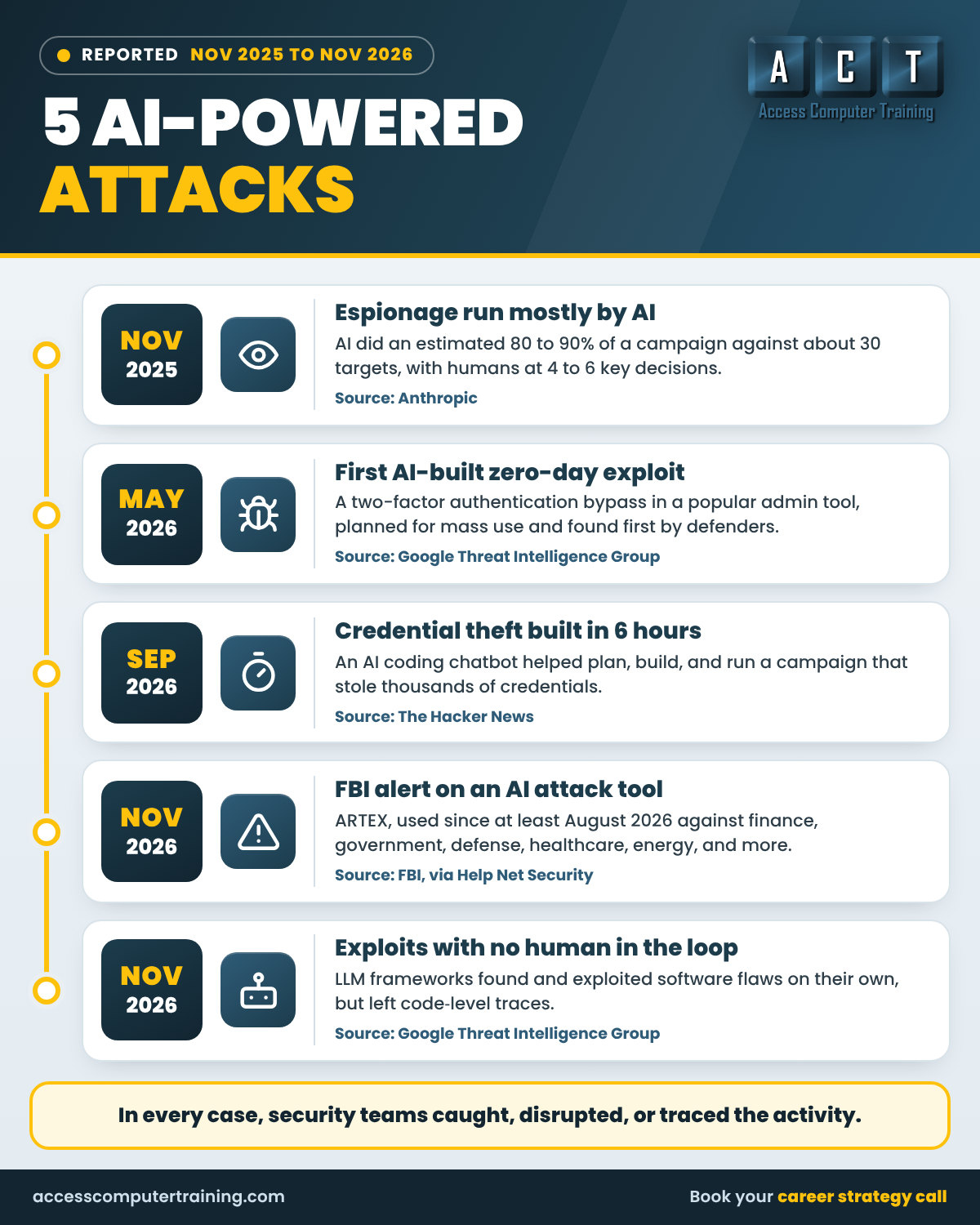
Side by side, a pattern appears. GTIG counted an average of 8 zero-day exploits a month in 2025, 11 a month in 2026, and 22 in August 2026 alone. LLMs are “shrinking the patch window for organizations,” and AI-written exploits that are claimed to work but don’t create “additional verification work for defenders.” Will AI replace cybersecurity jobs in a world like that? The evidence points the other way: more speed on offense means more work on defense.
Will AI Replace Cybersecurity Jobs or Just Certain Tasks?
Mostly tasks. AI is taking over the repetitive, high-volume parts of security work: sorting alerts, summarizing logs, scanning code for known flaw patterns, and drafting reports. People still own the judgment calls: deciding what is real, what matters, how to contain an incident, and how to explain risk to leaders.
That split is why the answer to “Will AI replace cybersecurity jobs?” keeps coming back no. AI takes over tasks, and people keep the job, as long as they learn to direct the tools.
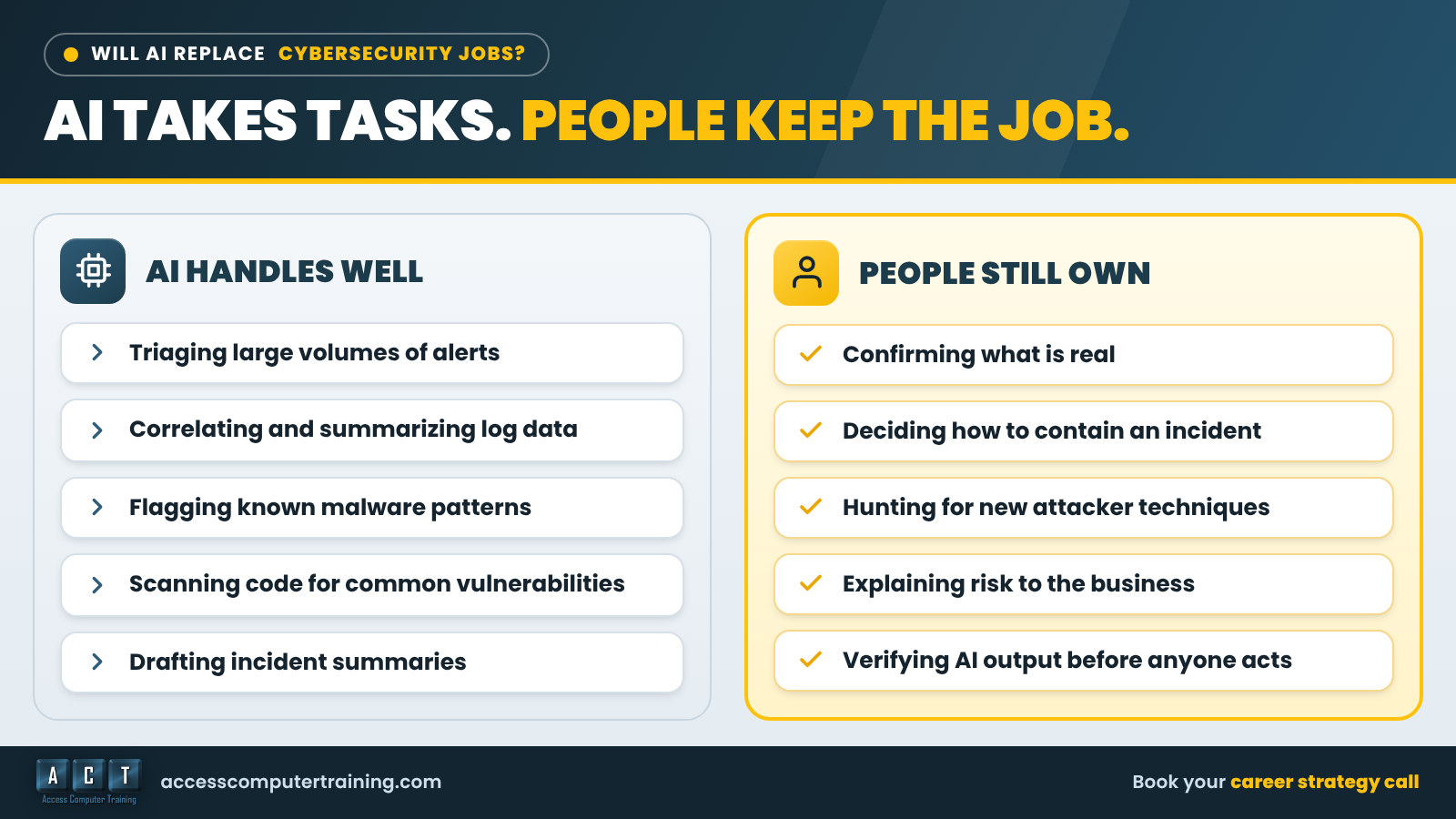
The future of AI in cybersecurity looks like teamwork. Even Anthropic, whose model was misused in the first attack above, advises security teams to “experiment with applying AI for defense in areas like Security Operations Center automation.” The security operations center (SOC) of the near future still has analysts, working alongside AI. Our guide to what a SOC analyst does explains the role.
Will AI Replace Cybersecurity Jobs, According to the Data?
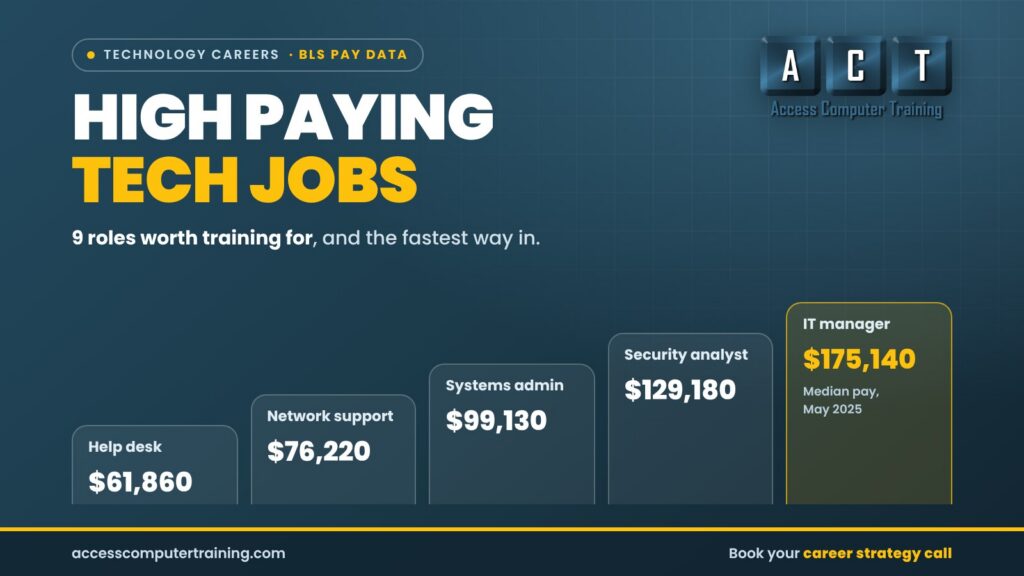
The data points to growth, not replacement. The BLS projects employment of information security analysts to grow 21% from 2025 to 2035, much faster than average, with about 14,100 openings a year and a May 2025 median wage of $129,180. The BLS also says increased use of AI has increased the need for enhanced security.
Security professionals in the ISC2 2025 study who named AI as their most pressing skills need.
Respondents in the same study who reported critical or significant skills needs on their security teams.
So will AI replace cybersecurity jobs? Not according to the people doing the work. ISC2 describes “a symbiotic future where AI enhances the cybersecurity working experience rather than replacing skilled personnel.” Globally, the World Economic Forum’s Future of Jobs Report 2025 lists networks and cybersecurity among the fastest-growing skills through 2030, right behind AI and big data.
Will AI Replace Cybersecurity Jobs at the Entry Level?
Entry-level roles are changing the most, but they aren’t disappearing. AI tools increasingly handle first-pass alert sorting that new SOC analysts used to do by hand, so beginners spend more of their time investigating, verifying, and escalating with context. Strong fundamentals in networking, operating systems, and security make that jump possible.
That’s why the traditional on-ramp still works: IT support or network support first, then a security role. Our guide on how to get a help desk job covers the first step, and Network+ vs Security+ helps you pick the next certification. The real question isn’t will AI replace cybersecurity jobs at the entry level, but whether new analysts arrive ready to work alongside it.
How Do You Future-Proof a Cybersecurity Career?
Build the skills AI can’t easily fake: networking fundamentals, hands-on investigation, and sound judgment. Then learn to use AI tools as part of the job. Certifications help prove those skills to employers, and the newest versions now test AI-related security topics directly.
- Master the fundamentals first Learn networking, operating systems, and how attacks work. AI output is only as useful as the analyst who can check it. CompTIA A+ and Network+ (N10-009) build that base.
- Earn Security+ on the version that fits your timeline Security+ V8 (SY0-801) launched November 17, 2026, with objectives on AI security risks and AI-assisted workflows. SY0-701 stays available in English until June 11, 2027.
- Practice with AI tools, and verify everything Use AI to summarize logs or explain an alert, then confirm the answer yourself. Even the attackers’ AI hallucinated results.
- Specialize in defense or testing CySA+ (CS0-004) builds detection and response skills, and PenTest+ (PT0-003) covers ethical hacking. Our red team vs blue team guide explains both sides.
- Learn how AI systems get attacked CompTIA says Security+ V8 covers prompt injection, model manipulation, and poisoning attacks. Once you have a few years of experience, CompTIA SecAI+ (CY0-001) goes deeper into securing AI systems.
Build Security Skills for the AI Era
Access Computer Training offers live, instructor-led Security+, CySA+, and PenTest+ prep online for Tampa Bay and all of Florida. Self-pay options are available, and workforce grant funding may cover part of the cost, depending on eligibility.
Book Your Career Strategy Call → or call 855-9-LEARNIT FL DOE Licensed · CIE License No. 5237How ACT Prepares You for Security Work in the AI Era
ACT prepares you with live, instructor-led certification training and the career support to land the role. Security+ prep is 60 hours across 15 live classes on Microsoft Teams, capped at 12 students, with every class recorded and the exam voucher and retake assurance included. Longer pathways add networking, analysis, and testing skills.
CompTIA Security+ prep
60 hours of live training, with the exam voucher and retake assurance.
IT Network & Security
212 hours over about 6 months: A+, Network+, and Security+, with three exam vouchers.
Cyber Defense & Incident Response
180 hours over about 6 months: Security+, CySA+, and PenTest+, with three exam vouchers.
- Practice exams, hands-on labs, performance-based question (PBQ) practice, ebooks, and study guides come with tuition
- Career planning, a resume rewrite, a LinkedIn profile audit, job-search strategy, and one-on-one career coaching
- Help exploring grants, if you qualify, and other funding options
Still asking yourself, “Will AI replace cybersecurity jobs?” Or wondering whether security is the right field at all? Read our honest look at is cybersecurity a good career, then see where security fits among other high paying tech jobs.
Frequently Asked Questions
Will AI replace cybersecurity jobs completely?
No evidence points that way. AI automates routine tasks like alert triage, but attackers use AI too, which raises the workload for defenders. Every attack in this guide was caught, disrupted, or traced by human security teams.
Will AI replace cybersecurity jobs in the next 10 years?
No one can predict a decade out with certainty, but the official outlook points to growth. The BLS projects employment of information security analysts to grow 21% from 2025 to 2035. Expect the daily work to change as AI tools improve, so plan to keep learning.
Will AI replace cyber security jobs for beginners?
Entry-level work is changing, not vanishing. AI tools increasingly handle first-pass alert sorting, so beginners spend more time investigating and verifying. Strong fundamentals and certifications like Security+ help new analysts prove they can do that work.
How is AI used in cybersecurity today?
Defenders use AI to triage alerts, summarize logs, spot unusual behavior, and find vulnerabilities first. Attackers use it to write phishing lures, build exploits, and automate campaigns. In the ISC2 2025 study, 69% of security professionals had integrated, were testing, or were evaluating AI tools.
Which cybersecurity jobs are safest from AI?
Roles built on judgment and accountability tend to be the most resilient, such as incident responders, threat hunters, security engineers, and leaders who decide how to handle risk. Jobs that supervise AI tools and verify their output are growing in importance too.
Does the new Security+ exam cover AI?
Yes. CompTIA Security+ V8 (SY0-801), launched November 17, 2026, includes objectives on the security risks of artificial intelligence and AI-assisted workflows. The SY0-701 exam remains available in English until June 11, 2027.
Final Thought
Will AI replace cybersecurity jobs? The past year’s attacks point to the opposite problem: AI is giving attackers speed, and organizations need more people who can match it. The analysts who thrive will be the ones who understand the fundamentals, use AI as a tool, and make the calls machines can’t.
Ready to Defend in the AI Era?
Talk with an Access Computer Training advisor about the Security+ path, upcoming class dates, and self-pay options. Workforce grant funding may cover part of the cost, depending on eligibility.
Book Your Career Strategy Call → or call 855-9-LEARNIT FL DOE Licensed · CIE License No. 5237